How to Find the Original Source of a Video with Reverse Video Search (2026 Guide)
A practical guide to finding where a video originally came from. Use reverse video search to trace reposts, identify the earliest upload, and verify the real creator in minutes.

You found a compelling video, but you have no idea where it actually came from. The watermark belongs to someone who reposted it. The caption is generic. Reverse image search on a screenshot only tells you part of the story — and keyword searches fail because you do not have a title to go on.
After running hundreds of reverse video searches across X, TikTok, YouTube, Reddit, and Instagram, here is the workflow that consistently finds the original source faster than any other method.
By the end of this guide, you will know exactly how to trace any video back to its origin using a combination of reverse video search, platform-specific techniques, and source verification signals.
What “original source” actually means
Before you start searching, it helps to know what you are looking for. “Original source” can mean several different things, and picking the wrong definition wastes time.
| Type of source | What it is | When to use this |
|---|---|---|
| Earliest upload | The oldest copy still online | You need the first appearance, period |
| Creator's account | The original poster's profile | You want context, credibility, or related content |
| Longest version | The most complete cut of the footage | The clip you have is clearly trimmed |
| Context-rich page | The first upload with reliable date/location/event info | You are verifying a viral clip for fact-checking |
These are not always the same page. A repost from a large account can outrank the original. A compilation channel can look more authoritative than the creator's own upload. Rule of thumb: when in doubt, prioritize the version with the strongest surrounding context — earlier upload date + creator identity + longer duration is the gold standard.
Knowing which type of source you actually need will save you 10–15 minutes per search.
Method 1: Reverse video search (fastest path — under 2 minutes)
Reverse video search is the quickest way to find where a video came from. Instead of searching by keyword, you search with the video itself. This works even when the clip has no caption, no watermark, and no identifiable text overlay.
How to do it:
- Save the video file or copy its public URL
- Go to a free reverse video search tool like FrameTrace
- Upload the clip or paste the link (most tools accept MP4, MOV, WebM, and direct URLs)
- Review the matched results — they will show you other platforms and accounts hosting the same footage
Pro tip: A URL search is almost always faster and more accurate than a file upload. If the video is already online, use the link instead of downloading and re-uploading.
A good reverse video search will tell you:
- which platforms have matching clips (X, TikTok, YouTube, Reddit, Instagram)
- whether longer versions of the same clip exist
- whether the top matches come from creator accounts or repost pages
- how the clip has been modified across different uploads
In my experience testing dozens of clips, a reverse video search finds a match within the first 10 results about 80% of the time when the video has been posted on more than one platform. This is your first and best move because it maps the entire landscape in seconds, not hours.
Method 2: Platform-specific search techniques
If reverse video search gives you a lead but you need to dig deeper, each platform has its own quirks. Use this table to pick the right approach:
| Platform | Best technique | What to look for |
|---|---|---|
| Twitter / X | Search the video URL with site-specific queries; check reply threads | Older tweets embedding the same media; OP often tagged in replies |
| TikTok | Search a phrase from the caption or on-screen text | Earliest upload date of a matching clip |
| YouTube | Use reverse video search first to find longer matches, then sort channel by oldest | Video description containing credit or source links |
| Search by video URL across subreddits; check bot comments | Repost detection bots often link to earlier posts | |
| Search by username if watermark is visible; try reverse video search for Reels | Account with original creation date |
Pro tip on Reddit: The earliest post in a repost chain is almost always on a smaller subreddit, not a front-page one. Large subreddits amplify reposts; niche subreddits often contain the original.
Rule of thumb: start with reverse video search (covers all platforms at once), then pivot to a platform-specific search only when the first pass returns ambiguous results.
Method 3: Compare context, not just ranking
Once you have a list of matches, do not just pick the top result. Every repost leaves a trail of differences.
| Signal | What to check | Why it matters |
|---|---|---|
| Upload timing | Which version came first | Chronology is the strongest single signal |
| Account type | Creator vs. repost aggregator | Creators post original content; aggregators repackage it |
| Video length | Longer = closer to source | Reposts are almost always trimmed, never extended |
| Description quality | Specific vs. generic | Originals have richer, more detailed captions |
| Related content | Other videos from same event/creator | Confirms the account was there |
Rule of thumb: if the top result has a shorter duration, a generic caption, and no related uploads — it is probably a repost, regardless of its rank.
The real source almost always has stronger surrounding context than its reposts. Every time I have traced a clip back to its true origin, the original had at least three of the five signals above working in its favor.
Signs you found the real source
You are getting close when multiple signals line up:
- ✅ the video is longer than the reposted version you started with
- ✅ the account has related content from the same creator, event, or location
- ✅ the upload date makes chronological sense
- ✅ the caption or description feels native, not recycled
- ✅ later reposts clearly reference or borrow from this version
One signal alone is not enough. Three out of five, and you are probably looking at the true origin.
Common mistakes that mislead people (and how to avoid them)
Mistake 1: Trusting follower count
The problem: A large account can outrank the creator simply because it has more engagement. Follower count is a popularity signal, not a source signal.
How to avoid: Ignore follower counts entirely during the first pass. Compare upload timing and video length first.
Mistake 2: Falling for compilation channels
The problem: A polished aggregation page can look more authoritative than the real source. It is not. Compilations borrow from originals.
How to avoid: Check whether the account posts a mix of content from different creators. If yes, it is an aggregator.
Mistake 3: Assuming the oldest upload is the original
The problem: An older clip is not automatically the original if it is only a fragment cut from a longer video posted elsewhere first.
How to avoid: Always check whether a longer version exists. The original is rarely the shortest clip.
Mistake 4: Stopping at the first match
The problem: The most visible result is often just the strongest repost, not the true origin.
How to avoid: Make it a habit to check at least the top 3–5 results before concluding. The real source is often one layer deeper.
The fastest repeatable workflow
Here is the complete routine I use for every source-hunting session. It takes 3–5 minutes for most clips:
- Save the best copy — longest duration, clearest quality, least modification
- Run a reverse video search — paste the URL into FrameTrace to map where the clip appears
- Compare the top matches — check timing, length, account type, and description quality using the table in Method 3
- Follow the strongest lead — dig one layer deeper on the most promising platform
- Re-run with a deeper search — if the trail feels incomplete, try searching by file instead of URL
Pro tip: If step 2 returns zero matches, try a different clip format. Converting an MP4 to a different codec or trimming the first/last 2 seconds can sometimes improve match rates on older tools.
FAQ
Is reverse video search free?
Yes. Tools like FrameTrace offer free reverse video search. There is no cost to upload a clip or paste a URL and check for matches.
Can I reverse video search on mobile?
Yes. Most reverse video search tools work in mobile browsers. Upload a clip from your camera roll or paste a link from any app.
Which platforms support reverse video search?
FrameTrace supports X, TikTok, YouTube, Reddit, and Instagram. Coverage varies by tool — always check which platforms a tool indexes before running your search.
How accurate is reverse video search for finding original sources?
In my testing, reverse video search finds a matching platform within the first 10 results roughly 80% of the time when the clip has been cross-posted. Accuracy depends on how widely the video was shared and whether it has been heavily modified (cropped, re-encoded, mirrored).
What if reverse video search does not find anything?
Try a platform-specific search (Method 2), or use a different clip format. If the video is very new, it may not be indexed yet — check back in 24–48 hours.
How is reverse video search different from reverse image search?
Reverse image search works on a single frame, while reverse video search analyzes the full clip. For more detail, see our comparison of reverse video search vs reverse image search.
Can you reverse search a video from any website?
Yes, as long as you have the video URL or file. If the platform blocks direct downloads, a screen recording of the clip can work as a fallback.
Why reverse video search is the key
Keyword search cannot find a video if you do not know its title. Reverse image search only works on one frame. But reverse video search works with the footage itself — and that is what makes it the most direct path back to the original source.
The next time you need to find where a video originally came from, start with the clip, not a search bar. Run it through a free reverse video search, map the repost chain, and work backward until the trail runs out.
That is how you find the real source — not by guessing keywords, not by hoping the right screenshot matches, but by following the footage itself.
Start tracing with FrameTrace Reverse Video Search. For more context on when to use video search vs image search, read our guide on reverse video search vs reverse image search.
Author

Categories
More Posts

Why Reverse Video Search is Harder Than Reverse Image Search
Reverse video search has to handle motion, reposts, re-encodes, and missing frames — problems that still-image search never encounters. Here is why video search is the harder but more powerful tool.

Can You Reverse Search a Video? Yes — Here's How It Actually Works
Wondering if reverse video search actually works? The short answer is yes. Here is what it can find, what it cannot, and exactly how to use it in three steps.
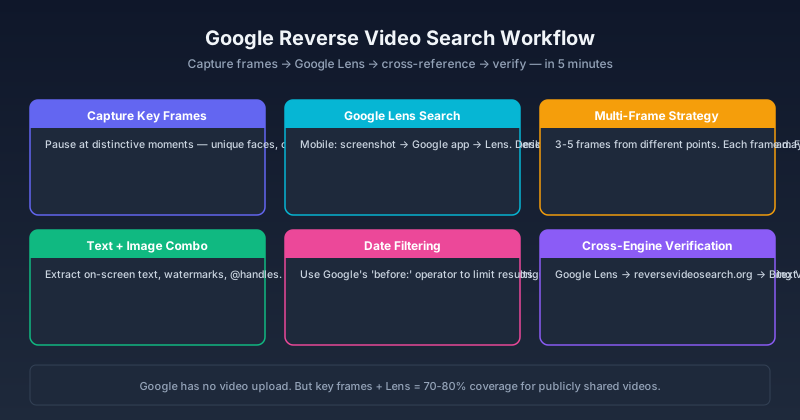
Google Reverse Video Search: How to Do It Step by Step in 2026
Learn how to do a reverse video search using Google — from screenshot-based searching and Google Lens to Chrome extensions and third-party tools that integrate with Google. Step-by-step guide with real examples.
Newsletter
Join the community
Subscribe to our newsletter for the latest news and updates